Part 1 – It’s Universal
I’ve been fascinated to the point of worship by the Golden Rule. At the age of six, after an overly harsh scolding, I hid in the basement and started crying. Amid the tears a warm realization poured over and into me, a bright white light that changed my short life completely. I realized love. That it is in us and around us. For my six-year-old brain, the way we live life was then and is now to embody the Golden Rule. I lived it. I had no choice. I was it and it was me.
In kindergarten we learned The Golden Rule:
“Do onto others as you would have them do onto you.”
It seems simple. Be nice. You wouldn’t like it if that (mean thing) was done to you. It is so simple that it is cliché, old fashioned. It’s easy to dismiss, easy to forget, and yet it gets to the core of mindfulness, gratitude and even affirmations. Its origins, in the west, are often attributed to the Bible.
The Gospel of Matthew (7:12): “In everything, do to others what you would have them do to you. . . .” This rule of conduct is a summary of the Christian’s duty to his neighbor and states a fundamental ethical principle.
Matthew is saying that being nice is an ethical principle. It is simply “the right thing to do”.
But let’s go back further. As far back as Confucious.
Confucianism (551-479 BCE) Zigong asked, “is there a single saying that one my put into practice all one’s life?” the Master said, “That would be ‘reciprocity’: That which you do not desire, do not do to others.” – the Analects of Confucius 15.24
The teacher specifically mentions reciprocity. Seemingly, he is saying there is a give and take in being kind. By answering the question to say that “reciprocity” is a practice to live one’s life, he implies the law of cause and effect, karma. He seems to be saying that just plain being nice to others has a deeper value in living. More than just being right, you’ve invested in the Law of Reciprocity. You get back what you put out.
Choosing kindness makes it easier for us, and it enables others, to choose kindness. When I help you lift your load, you are grateful and willing to help another person with their load. We feel that we have done something good. Good is now present in us.
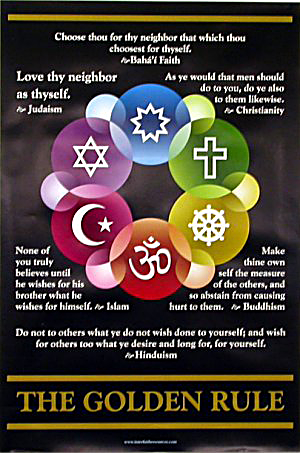
This is so profound that every major religion has some form of the golden rule as a main tenet of their belief.
| Religion | Expression |
| Judaism | That which is hateful to you do not do to another: that is the entire Torah and the rest is its interpretation. Go study. – Talmud Shabbat 31 a |
| Christianity | “In everything, do to others as you would have them do to you. For this is the law and the Prophets -New Testament, Matthew 7:12 |
| Islam | None of you truly believes until he loves for his brother what he loves for himself – 40 Hadith 13 |
| Baha’i Faith | Lay not on any soul a load which ye would not wish to be laid upon you, and desire not for any one the things ye would not desire for yourselves. -Gleanings from the Writing of Baha` ‘ uallah, page 128 |
| Buddhism | Hurt not others in ways that you yourself would find hurtful – Udananvarga 5:18 |
| Jainism | In happiness and suffering, in joy and grief, we should regard all creatures as we regard our own self, and should therefore refrain from inflicting upon others such injury as would appear undesirable to us in inflicted upon ourselves – Yassatra |
| Confucianism | Zigong asked, “is there a single Saying that one my put into practice all one’s life?” the Master said, “That would be ‘reciprocity’: That which you do not desire, do not do to others.” – the Analects of Confucius 15.24 |
| Taoism | Regard your neighbor’s gain as your own gain, and your neighbor’s loss as your own loss. Lao Tse’s Treatise on the Response of the Tao |
| Wicca | Ever mind the Rule of Three – Three times your acts return to thee. This lesson well, though must learn. Though only gets what thee dost earn. –The Rule of Three |
| All information in the table above was Taken from an image By Di (they-them) – Own work, CC0, | |
| Sikhism | “I am a stranger to no one; and no one is a stranger to me. Indeed, I am a friend to all.” [Source: Guru Granth Sahib, p.1299] |
For me, this is proof that all religions stem from one universal feeling, Love.
And that will be the next post.
Namaste


 Obimaya Meditative
Leave a comment